I know I already produced a list of what marine species are okay to eat/not eat, but the MCS have produced many web pages to help people to buy more environmentally smart.
http://www.fishonline.org/buying_eating/purchasing_guide.php
- this page is a purchasing guide which instructs what is best to buy and when.
http://www.fishonline.org/search/simple/
- this page is a basic search engine where you can look up your marine species of choice and find out all the facts you need to know about it, before trotting off to the supermarket.
http://www.fishonline.org/information/faqs/
- this is a page of FAQ's all fully answered with links.
http://www.fishonline.org/information/MCSPocket_Good_Fish_Guide.pdf
- this is the pocket guide for simple information, fast.
Sunday, 8 August 2010
Wednesday, 21 April 2010
Climate change to cause a stir..

Scientists have warned that climate change is likely to cause more environmental damage in the form of volcanoes, earthquakes and tsunamis. It has been feared for a while that the natural disasters we have experienced in recent times have been more violent than we have experienced before, and the Royal Society are putting this down to climate change; claiming that "even the smallest change in our environment" could cause big repercussions. Big changes in rising sea levels, melting ice caps and freak weather will be the culprits that could trigger natural disasters, and as certain recent events show, we are no equipped to handle the aftermath.
They are also warning of "ice-quakes", break up in ice sheets which could trigger big tsunamis. Scientists also claim that if all the ice were to melt, then it could trigger earthquakes due to pressue the ice once had on the earth being released.

Thursday, 11 February 2010
Save Chagos Reef - petition

Just had a petition pased on to me that is quite important.
The Chagos Islands are an area under British jurisdiction in the Indian Ocean. It is home to a large coral atoll and amazing ocean life. The reef needs to be protected to ensure its long term survival and the safeguarding of all the life whom live on, or feed off such a beautiful area.
The petition is to try and ensure the area becomes a no take zone so that we can try and preserve this area of such outstanding beauty, however sadly there is a time limit -the petition must be passed onto the government by February 12th.
Please sign the following petition and browse the website for more information.
http://protectchagos.org
Thank you :)
Wednesday, 10 February 2010
Doing your bit for our oceans...

Apologies for not updating in a while - had a few problems with the account. Thankfully is now back up in full running order.
With many sea species in threat of extinction, I just wanted to post a little bit about what to do and what not to do - just some basics.
A lecturer once said to me that instead of trying to fight humans against nature, we must work along side each other. So when facing the problems which have become increasingly important in recent years, it is not enough to simply tell people to stop making mistakes, and instead we must take human actions into account when planning for our future.
The consumption of fish has been important for thousands of years. They have always been a good source of protein and have recently become even more important by eing labelled as a 'brain food', due to being a good source of Omega 3, as well as delicacies such as Blue Fin Tuna used in Sushi. But everyone by now knows that fishing is causing huge problems to our oceans and consuming the 3 pieces of recommended fish a week could leave stocks so depleated that many species could become extinct. Overfishing and fishing styles are mostly to blame for this terrible loss.
Scientists latest prediction is that fish stocks for many species could be exhausted by 2048 unless sustainable fishing comes into play. Although slowly changes are being made, the UK Marine Bill hopes to accomplish no fishing zones in order to give safe havens where Fish stocks can replenish themselves. Big supermarkets such as Marks and Spencer's and Waitrose have also promised to stop selling endangered species and instead sell more sustainable species like Yellowfin Tuna. But what will this really mean? Sadly, it is likely to mean that although there will be areas for fish to be safe, it will be our fishermen who suffer the greatest loss and although fishing techniques are largely to blame, we have to consider these people's livelihoods and futures. Other countries will not be participating and therefore some of the worst offending countries will still be continuing their detrimental practices.
So what can the evryday consumer do? Well, when choosing fish there are certain species you should try and avoid. You should also try to buy sustainable fish that you know comes from a good, fair source that is good for both the oceans and the fishermen - supporting local fishermen is even better. You can buy farmed fish, Salmon, Tuna etc. which may be more sustainable, however farmed fish does raise some other important issues (I'll raise that in another post though!)
The Marine Conservation Society has published lists of fish and seafood it is okay to eat and those to avoid. Sadly the list of species to avoid is longer!
Fish to enjoy -
http://www.fishonline.org/advice/eat/
Fish to avoid -
http://www.fishonline.org/advice/avoid/
If you want to delve a little deeper, there are some wonderful texts currently available on the subject:
- Grescoe, Taras, 2008. 'Bottomfeeder - how the fish on our plates in killing our planet' A wonderful tale of Gresco's year-long trip around the world sampling many marine species and uncovering the destruction of our oceans.
- Roberts, Callum, 2007. 'The unatural history of the sea - the past and future of humanity and fishing' A look at the relationship between humans and the ocean throughout history, with more chilling conclusions about the future.
- Girling, Richard, 2007. 'Sea Change - Britain's coastal catastrophe' Focusing on Britain's behaviour with regard to the ocean. A fascinating and passionate account of our treatment of the coast.
- Bely, S and Bely, P, 2007. 'Do dolphins ever sleep?' This is a really nice book which answers basics and random questions on our seas, with topics such as animals, sailing, weather and basic sciecne. A fantastic text for people looking for basic information on our oceans.
Tuesday, 30 June 2009
Extinction threatens Shark populations
New reports saying that nearly a third, 32% in fact, of all sharks, rays and skates are under the threat of extinction - and overfishing is to blame. The IUCN has released a list of 64 species which are under serious threat. The list includes Scalloped hammerhead (Sphyrna lewini), Striped Catfish (Pangasianodon hypophthalmus) and Silver shark (Balantiocheilos melanopterus).
Two of the most recognizable species of shark, the Scalloped Hammerhead and the Oceanic Whitetip (Carcharhinus longimanus) are under serious threat. It is thought that both species have declined by 99% in recent years - a shocking statistic.
Sharks do not have large litters of young and they are slow to mature, with some species taking decades to reach sexual maturity. Due to this, they need time to develop - something they are not getting due to fishing. For years, sharks were merely a bycatch; useless and insignificant, their reputations tarred by media hype. However in recent times they have become somewhat of a delicacy caught and used for shark-fin soup. As it is considered such an elegance by the rich, the soup has become more sought after and demand has sky rocketed.
The fear for the global shark populations is growing and more and more are understanding how much we need to save our sharks. Spread the message!
For more information and to help out, contact the Shark trust at
Two of the most recognizable species of shark, the Scalloped Hammerhead and the Oceanic Whitetip (Carcharhinus longimanus) are under serious threat. It is thought that both species have declined by 99% in recent years - a shocking statistic.
Sharks do not have large litters of young and they are slow to mature, with some species taking decades to reach sexual maturity. Due to this, they need time to develop - something they are not getting due to fishing. For years, sharks were merely a bycatch; useless and insignificant, their reputations tarred by media hype. However in recent times they have become somewhat of a delicacy caught and used for shark-fin soup. As it is considered such an elegance by the rich, the soup has become more sought after and demand has sky rocketed.
The fear for the global shark populations is growing and more and more are understanding how much we need to save our sharks. Spread the message!
For more information and to help out, contact the Shark trust at
Saturday, 13 June 2009
What does the rain cloud wear under his rain coat?
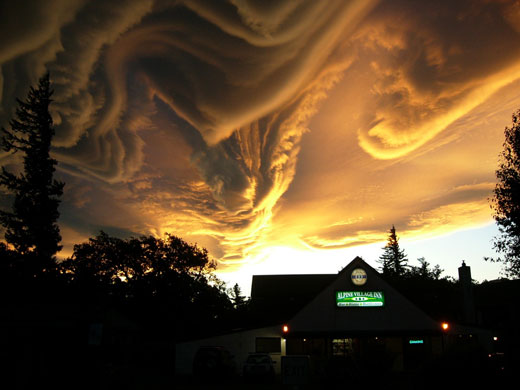
Thunder wear!
So it seems that a new type of cloud has been discovered, for the first time since 1953. Named "Asperatus" after the Latin for 'rough', the clouds are thought to form in a similar way to storm clouds with a "choppy" effect, however a storm does not ensue.
The cloud was discovered by none other than Gavin Pretor-Pinney, founder of the fantastic Cloud Appreciation Society. Pretor-Pinney said he noticed the cloud when trying to identify clouids in photographs sent in by fans. Realising that some of these did not fit into existing categories, he figured there must be a whole new one.
Research by The Royal Meteorological Society is now underway to try and understand the cause of Asperatus clouds, and will be classified in the same manner all clouds are classified internationally: where they are formed atmospherically, their appearance, their shape and the amount of moisture they hold.
P.S, just a thought how it is interesting that this discovery just so happens to tie in with Pretor-Pinney's new book....
Wednesday, 27 May 2009
Peta's Boycott


The animal rights group Peta are still fighting against the seal massacre which happens every year in Canada. Despite years of protest, Canada still allowers seal clubbing to occur for skins which many claim are 'uneeded and unused'.
Peta is rallying for everyone to boycott one of Canadas main exports - Maple Syrup. Canada provide 85% of the worlds maple syrup, which is a popular product over in the US, made particularly popular from the famous 'maple syrup diet' (Hmm!)
Peta ask that everyone pledge not to buy Canadas export until they stop the baby seal slaughter that happens yearly. Peta say they will send a copy of your pledge directly to Canadian Prime Minister Stephen Harper and Canada's Minister of International Trade Stockwell Day to plead for an end to this annual bloodbath.
To do your bit, please go to their website and make your pledge:
https://secure.peta.org/site/Advocacy?cmd=display&page=UserAction&id=2209
Subscribe to:
Posts (Atom)